
What do we mean by wildflowers?
I have noticed recently that ‘wild’ is used in so many different contexts, with varying meanings and I thought I would write a blog about what wild means to me.
Wild.
I often get emails saying “I love your wildflowers” or “I’d like my bridal bouquet to include wildflowers”. It is lovely to get enthusiastic emails, but is also makes me feel a little confused, because as a flower farmer my flowers are the opposite of wild; I very purposefully cultivate a field of cut flower varieties, many of which are the result of intensive hybridising, to a strategic plan to ensure a long season of flowers. Grown in harmony with nature, using regenerative techniques, my flowers are environmentally friendly. And I use these flowers to create wild-looking, naturalistic arrangements. But they’re not themselves wild.
What are wildflowers?
The Oxford English Dictionary defines ‘Wild Flower’ as a flower of an uncultivated variety or flower growing freely without human intervention.
This doesn’t describe our flowers!
In the UK wildflowers can be found in meadows and open countryside, woodland, verges and wasteground. Examples of native wildflowers include the cornflower, dog rose, buttercups and wood anemone.
The decline of wildflower meadows
Did you know that in the UK we have lost 97% wildflower meadows since the 1930s! I grew up in Swaledale surrounded by beautiful wildflower meadows. (My dad Colin Smithson painted them - I’ve included a painting by him below!) The industrialisation of farming, the increased use of chemical herbicides and the growth and development of our conurbations has led to this devastating decline.


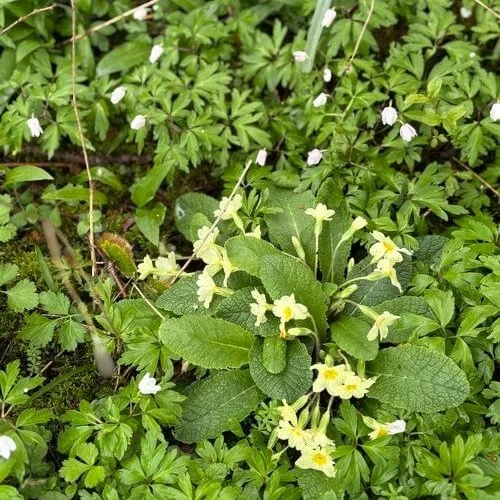
Why are wildflowers and wildflower meadows important?
Wildflower meadows are important because:
they provide food for bees, butterflies and other pollinators, which are important for pollinating our fruit and veg plants, and are themselves food for other insects and birds.
Biodiversity is in crisis; as a result of overexploitation, pollution and development, we are seeing the decline in number and variety of butterflies, pollinators, mammals, birds and plant life. Meadows can have over 100 different plants in them, providing important habitat for insects, birds and mammals. Think of the shrew, the curlew, the lapwing…
Rich meadows have complex root systems that sequester carbon in the soil, and also stabilise the soil so that it does not wash away in heavy rain AND helps slow the run off of the rain into the waterways, helping reduce downstream flooding.
Did you know that wildflower meadows sequester as much carbon as woodland?!
We need more wild spaces and diversity of plants to increase the number and variety of birds, insects, pollinators and mammals. Excellent information can be found at the WWF website.
If you don’t grow wildflowers, what does Cumberland Flower Farm grow?
Many of the flower varieties we grow are enjoyed by bees, butterflies and other pollinators, but they’re not necessarily native or originally wild here. The flowers that we grow can be divided into three categories:
Native flowers
Examples include cornflower, silver birch foliage and yarrow (achillea millefolium)Non native flowers that make good cut flowers
Amaranth, echinacea and limonium for example.Flowers that have been developed for particular qualities
Examples include roses, sweet peas, sunflowers and ranunculus. Ruffles? Blush, salmon, brown, or coral? Long lasting, long stemmed stems… all these attributes are designed into a variety.
A lot of flowers that we consider ‘quintessentially English’ like roses, or peonies and tulips have origins a long way from here!
Where do our favourite flowers originate?
Roses: Originally from China, Roses came to Europe where hundreds of varieties were developed by breeders, famously by David Austin in this country.
Tulips: Tulips originate from central Asia and were first cultivated in Turkey before coming to Europe in the 16th Century.
Zinnia: It’s no surprise that they can struggle in Cumbria, because Zinnia come from Mexico and the scrub, dry grasslands of Central America.
Peony: Peonies come from China originally, where they have been cultivated for thousands of years. They’ve been cultivated in Japan, Europe and America.
Dahlia: Native to Central America, Dahlia were brought to Europe by Spanish colonists in the 18th century.
Indeed, many of our the flowers we find in our gardens came here as a result of our position as white colonisers and traders. Our English country gardens illustrate our multicultural history; what we consider English was acquired or appropriated as dominating colonialists.
Whilst these flowers are not wild or even native to the UK, they are great cut flowers and they help create a very naturalistic, wild-looking aesthetic that you love.
What is a Wild Style bouquet?
Wild Style is used to describe a naturalistic aesthetic that reflects the natural world. In contrast to traditional floristry that is quite formal and formulaic, wild styling allows for freer, looser, more natural movement, shape and textures in an arrangement. When you ask for a wild bouquet I mean something that’s more unstructured in shape and movement than a tight, compact, in-the-round bouquet.
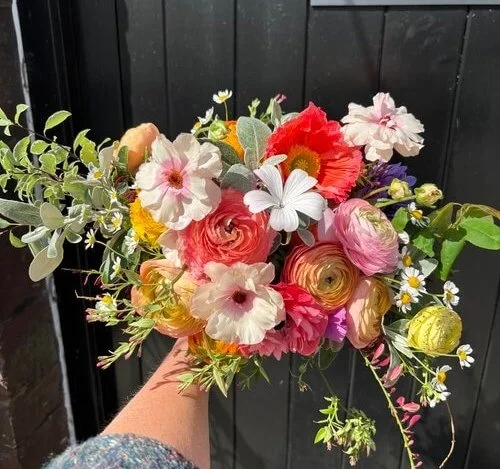
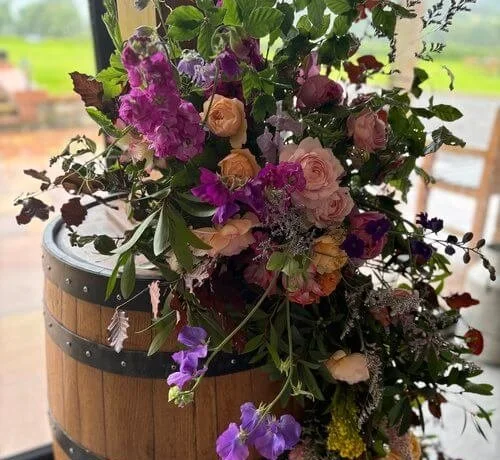
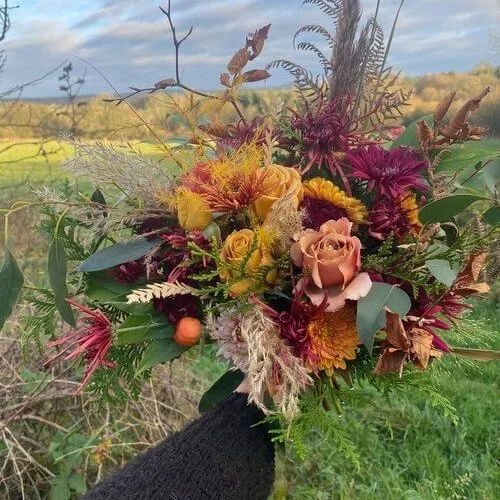
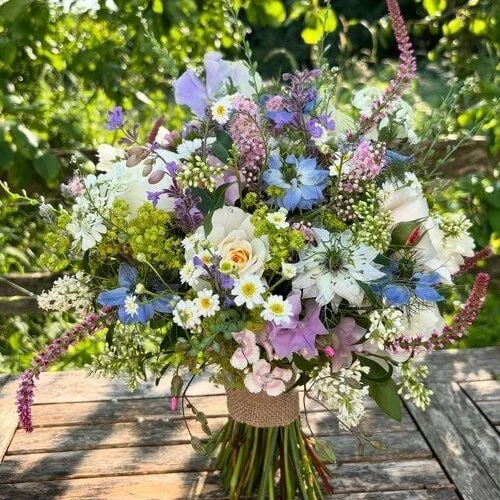
The last bouquet pictured here - Amy’s bouquet - was created with wild-looking flowers in a more compact shape, unlike the other three which epitomise my ‘wild style’.
Amy liked the compact shape but requested a wildflower bouquet, so I incorporated lots of wild and wild-looking flowers. We choose to grow a large number of different flowers and varieties of flowers to be able to create this look. Alongside native flowers like cornflower and achillea, we also grow things that look like they are wild. For example we grow Icelandic Poppies from a variety of sources to ensure we have a wide range of colours and shapes. Icelandic poppies are undeniably ‘poppy’ but have a much better vase life than the wild sort. Similarly, we grow roses in so many colours and shapes - including many David Austin varieties - but we also grow one that is not unlike a dog rose, with a single, open cup-shaped flower, exquisite stamen, a sweet scent, and long life in a vase. It looks wild, even though it is not.


Wild-looking flowers
I totally understand why you might think my flowers are wild. In comparison to the flowers that you can buy elsewhere, they look and feel that way. And that is something I choose to celebrate! Seasonal flowers allow us to tap into what is going on in the wild: spring flowers capture the excitement of spring, the rich colours and textures of autumn flowers connect us with the changing trees and wilder weather outside.
In a world that is getting increasingly standardised, I think its a something we unconsciously value and connect with. It’s definitely not a bad adjective to use, and I hope this blog explains what the word ‘wild’ means to me.